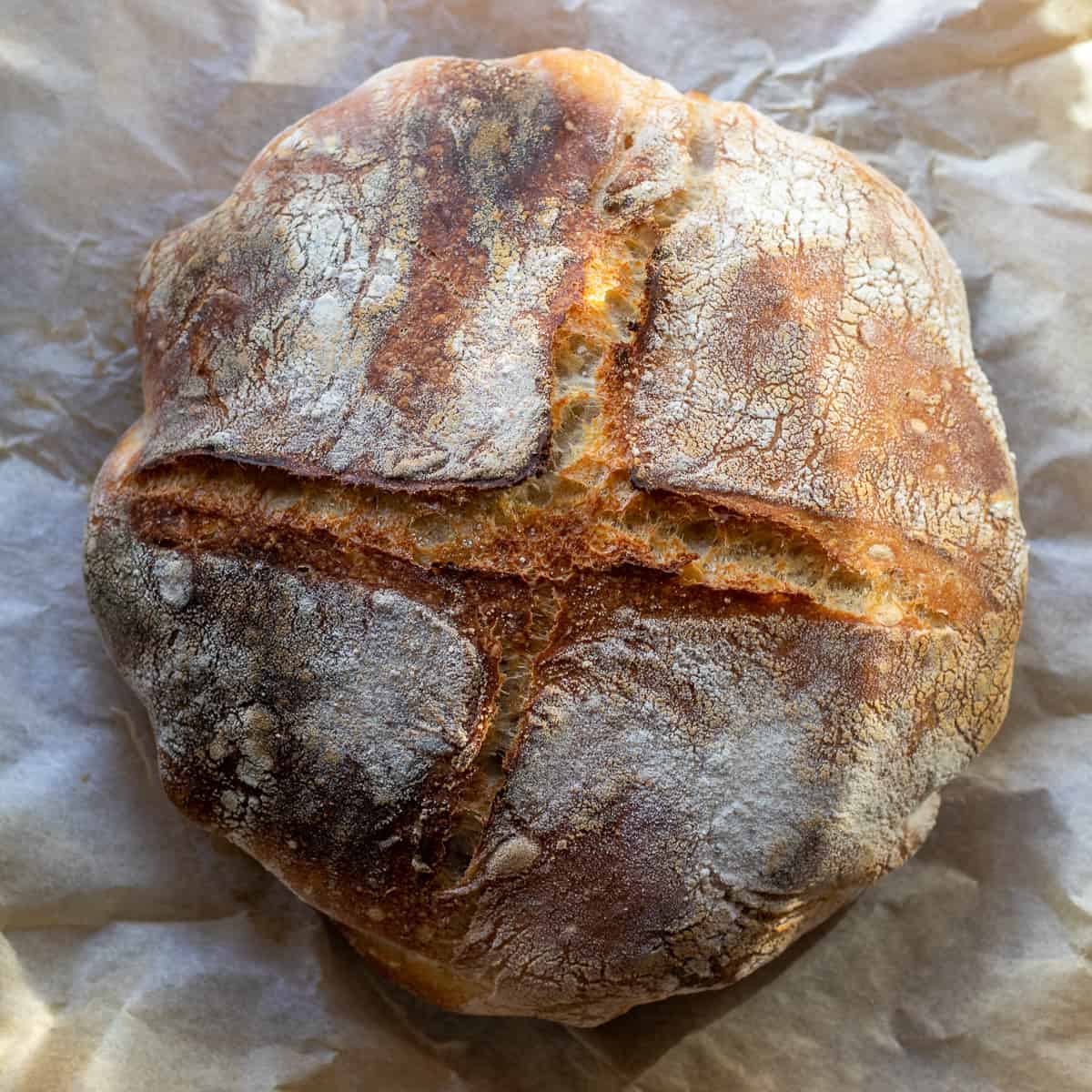
Dutch Oven Sourdough Bread
If you're looking for a new baking challenge that will leave you feeling proud, this recipe for Dutch Oven Sourdough Bread is just what you need.
Servings: 12 slices
Calories: 169kcal
Equipment
- 1 kitchen scale
- 1 Lodge Dutch oven
- 1 bread scorer
- 1 Sharp knife
Ingredients
- ½ cup active sourdough starter (120 grams)
- 4 cups plain white flour / all-purpose flour (500 grams)
- 1 ½ cups water (360 ml)
- 2 teaspoon salt
- 1 ½ teaspoon honey
- 3 tablespoon rice flour (for preventing the dough sticking to dutch oven)
Instructions
Mixing the Dough
- To activate your sourdough starter, you'll need to do it 12 hours before you want to start making your Dutch Oven Sourdough Bread.
- Mix 1 ½ (40 grams) of sourdough starter with 1 ½ oz (40 grams) of water and 1 ½ (40 grams) of all-purpose flour (plain flour). Cover it with a lid or cling film and leave it somewhere warm for 12 hours, or until you're ready to use it.
- In a large mixing bowl, combine the active sourdough starter, all-purpose flour, honey (optional), and water. Mix until there are no dry spots. Cover the bowl with a clean tea towel and let it rest for 30 minutes.
- After 30 minutes, add the salt to the dough. Mix until well combined. You can use your hands or a wooden spoon to mix the dough. The dough will be sticky, but that's normal.
- Cover the bowl with a tea towel and leave it to rest for 45 minutes.
Stretching and Folding
- After the dough has rested for 45 minutes, it's time to use the stretch-and-fold method. This method helps the gluten develop, which is what gives sourdough bread its signature chewy texture.
- To do the stretch-and-fold method, wet your hands and grab the dough from the bottom of the bowl. Stretch it upwards and fold it over itself. Rotate the bowl a quarter turn and repeat the process.
- Do this four times, so you've done a full rotation. Cover the bowl with a tea towel and let it rest for 30 minutes. Repeat the stretch-and-fold method three more times, with 30-minute rests in between each round.
Proofing and Shaping
- After the last stretch-and-fold, let the dough bulk ferment at room temperature overnight, for about 8-12 hours. This is called the bulk fermentation stage, and it allows the dough to rise. The timing might vary depending on the season and the temperature of the room.
- Lightly flour a clean surface and gently scrape the dough out of the bowl onto it. Make sure not to deflate the dough too much.
- Shape the dough into a ball by pulling the sides towards the center and pinching them together. Then, flip the dough over so that the smooth side is facing up.
- Place the dough into a glass bowl lined with a towel that's been dusted with rice flour, with the seam side facing up. You can also use a banneton basket dusted with rice flour.
- Cover the dough and let it proof for another 30 minutes to an hour, or until it has visibly risen and feels puffy.
Baking in a Dutch Oven
- While the dough is proofing, preheat your oven to 230° C (450° F) and place your Dutch oven inside to preheat as well.
- Place a long piece of parchment paper over the bowl with the dough. Flip the bowl over onto the countertop so that the dough is now on top of the parchment paper. The dough should hold its shape without collapsing.
- To help the dough expand evenly in the oven, use a sharp knife or a razor blade to score the top with a decorative pattern. You can score in the areas where you want the dough to puff up, preventing random cracking.
- With the help of parchment paper, gently transfer the dough into the preheated Dutch oven. Place a few ice cubes underneath the parchment to create steam and help the bread rise better.
- Put the lid back on and bake it for about 20 minutes.
- Take the lid off, reduce the temperature to 200℃ (390℉), and bake it for another 25-30 minutes, or until the crust is a beautiful golden brown and the bread sounds hollow when you tap it underneath.
- Take the bread out of the Dutch oven and let it cool on a wire rack for at least an hour before slicing and serving.
Video
Notes
- Make sure your sourdough starter is active, strong, well-fed, and at its peak with lots of bubbles.
- Use a digital kitchen scale to measure your ingredients accurately.
- The stretch and fold method helps the gluten develop, giving sourdough bread its signature chewy texture.
- Bulk fermentation might vary depending on factors such as the temperature, strength of the sourdough starter, and type of flour used. Warmer temperatures speed up fermentation, while colder temps slow it down. A strong starter works faster than a weaker one, and different flours ferment at different rates.
- To help the dough expand evenly in the oven, use a sharp knife or a razor blade to score the top with a decorative pattern.
- Preheat your Dutch oven before adding the bread dough to ensure even heat distribution.
- Let the bread cool completely before slicing to prevent it from becoming gummy.
- If you don't have a Dutch oven, you can use a baking stone or a cast iron skillet instead.
Nutrition
Calories: 169kcal | Carbohydrates: 34g | Protein: 5g | Fat: 1g | Saturated Fat: 0.1g | Polyunsaturated Fat: 0.3g | Monounsaturated Fat: 0.1g | Sodium: 390mg | Potassium: 44mg | Fiber: 1g | Sugar: 1g | Vitamin A: 1IU | Vitamin C: 0.004mg | Calcium: 8mg | Iron: 0.4mg