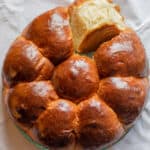
Fluffy Japanese Hokkaido Milk Bread Recipe
Japanese Hokkaido Milk Bread, also known as Shokupan, is a soft and delicate white bread with a cloud-like texture that practically melts in your mouth.
Servings: 9 rolls
Calories: 217kcal
Equipment
- 1 kitchen scale
- 1 Measuring cups
- 1 measuring spoons
- 1 9" springform cake tin
Ingredients
For Tangzhong
- 2 ½ tablespoon strong white bread flour
- ⅓ cup water
For the Dough
- 2 ½ cups strong white bread flour
- 2 ¼ teaspoon fast action dry yeast
- ¼ cup caster or granulated sugar
- 1 teaspoon salt
- ⅓ cup tangzhong (cooled down to a room temperature)
- ½ cup full-fat milk (whole milk) (lukewarm)
- 1 large egg
- 3 ½ tablespoon unsalted butter (melted and cooled down)
For Glazing
- 1 small egg
Instructions
Preparing the Tangzhong
- In a small saucepan, combine the strong white bread flour and water. Whisk them together until there are no lumps and the mixture is smooth.
- Place the saucepan over medium heat and continuously whisk the mixture as it cooks. Keep whisking to prevent any clumps from forming.
- Cook the mixture until it thickens into a gel-like consistency. This typically takes about 2 to 3 minutes. You will notice that the mixture becomes thicker and more viscous as it heats up.
- Once the tangzhong has thickened, remove the saucepan from the heat and let it cool completely. The tangzhong should have a smooth and sticky texture.
Forming the Dough
- In a mixing bowl of a mixer fitted with the dough hook attachment, combine white bread flour, fast-action dry yeast, sugar, and salt. Mix them until well combined.
- Add cooled tangzhong (at room temperature), lukewarm milk, and 1 large egg. Mix on low speed until a rough dough forms.
- Add the melted butter gradually, and then increase the speed to medium.
- Knead the dough in the stand mixer for about 8-10 minutes, or until it becomes smooth, and elastic, and pulls away from the sides of the bowl.
- Shape the dough into a ball and place it in a greased bowl.
- Cover the bowl with a clean kitchen towel or plastic wrap and let it rise in a warm place for about 1 to 1.5 hours, or until it doubles in size.
Shaping the Dough for Rolls
- Divide the risen dough into 9 equal portions.
- Take each piece and bring all of the edges towards the center to create a compact ball.
- Flip the ball over so that the seam side is facing downwards.
- Using your palms, cup the dough ball and rotate it on the work surface to create surface tension. This will help the dough keep its shape during baking.
- If the dough feels sticky, use a little flour as needed to prevent it from sticking to your hands.
- Repeat the process for the remaining portions of dough until all the balls are shaped.
- Place the shaped rolls into a lightly greased 23 cm (9") springform cake tin or a baking dish of approximately 23cm x 23cm (9 inches x 9 inches) in size or equivalent.
- The rolls should be positioned so that they are lightly touching each other, but not too tightly packed.
- Cover the baking dish with a clean kitchen towel and let the dough rise for another 45 minutes to 1 hour, or until the rolls have doubled in size.
Baking the Bread Rolls
- Preheat your oven to 180° C (350° F).
- Once the dinner rolls have risen, if desired, brush the tops with a beaten egg for a shiny crust.
- Bake them in the preheated oven for about 20-25 minutes, or until they turn golden brown and sound hollow when tapped on the bottom.
- Remove the bread from the oven and let them cool on a wire rack before serving the dinner rolls.
Shaping the Dough for Loaf
- For the loaf method, divide the dough into three equal pieces. Turn them into balls.
- Flatten each dough roll into a rectangular, and fold the long sides towards the middle.
- Roll it tightly from the short side into a log/spiral shape and pinch the seam to seal. Place it to a prepared 9" loaf pan, and repeat with the other 2 rolls.
- Cover the loaf, let it rise for 45 minutes, brush with a beaten egg, and bake in a preheated oven for 25-30 minutes, or it is deep golden brown.
Video
Notes
- Baking is a science, so make sure to measure your ingredients accurately. Use a for precise measurements, especially for flour and liquids, to ensure consistent results.
- It's essential to let the tangzhong cool down to room temperature before adding it to the dough.
- Proper kneading develops gluten, contributing to the bread's structure and texture. Knead the dough until it becomes smooth and elastic, and springs back when lightly pressed.
- Give the dough enough time to rise properly. Use the timings provided in the recipe as a guide, but be mindful of the room temperature and make necessary adjustments. The key is to ensure that the dough doubles in size during the rising process.
- Find a warm spot in your kitchen for the dough to rise. Avoid exposing it to drafts, as they can affect the fermentation process and result in uneven rising.
- For a beautiful golden crust, brush the shaped dough with an egg wash before baking. This gives the bread an attractive sheen and adds a touch of richness.
- Every oven is different, so keep a close eye on your bread while it bakes. Follow the recommended temperature and time in the recipe, and adjust if necessary to achieve a perfectly baked loaf.
Nutrition
Calories: 217kcal | Carbohydrates: 33g | Protein: 6g | Fat: 6g | Saturated Fat: 3g | Polyunsaturated Fat: 1g | Monounsaturated Fat: 2g | Trans Fat: 0.2g | Cholesterol: 50mg | Sodium: 280mg | Potassium: 79mg | Fiber: 1g | Sugar: 6g | Vitamin A: 212IU | Vitamin C: 0.002mg | Calcium: 30mg | Iron: 1mg